Notre-Dame and Quasimodo’s symbiosis
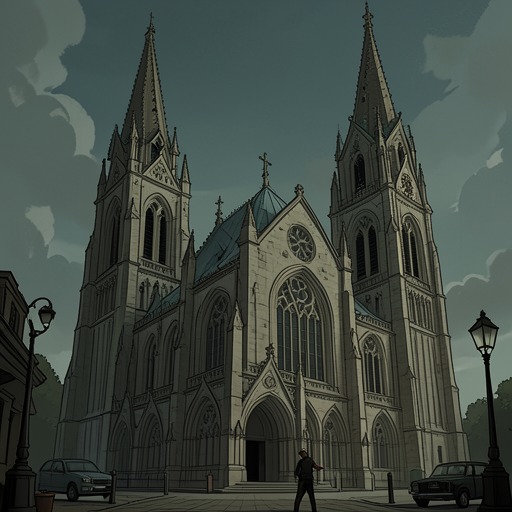
The Hunchback of Notre DameNotre-Dame and Quasimodo’s symbiosis is a relationship of shelter, adaptation, and apparent mutual animation: the cathedral becomes Quasimodo’s entire world, while he comes to seem like its living spirit. The bond is more than an attachment to a home. The narration describes a man and an edifice as growing into one another, until Quasimodo’s movements animate the church and the church’s spaces seem shaped for him. Their union gives physical form to his separation from human society and to the novel’s vision of Notre-Dame as a living presence.
Formation of the Bond
Quasimodo’s intimacy with the cathedral begins in the conditions of his life. His unknown birth and natural deformity separate him from the world, and from infancy he is enclosed within the religious walls that receive him. As he grows, Notre-Dame becomes, in succession, his egg, nest, house, country, and universe. The progression measures how thoroughly one place has taken the place of every broader social and geographical world he cannot enter.
The bond is presented as an affinity between a particular body and a particular building. As a small child, Quasimodo crawls beneath the vaults with awkward, jerking movements; his human face and animal-like limbs seem to belong naturally among the shadows and strange shapes cast by the Romanesque capitals. The description does not make his body literally architectural. Instead, it renders his exclusion and his sense of belonging through the visual correspondence between his form and the cathedral’s strange, irregular spaces.
The Cathedral as Home and World
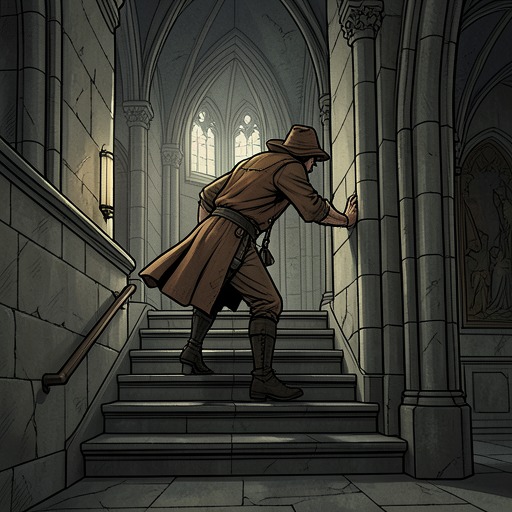
Quasimodo lives and sleeps in Notre-Dame and hardly ever leaves it. The building is not simply familiar to him: he has explored its depths and scaled its heights. Uneven carving gives him footholds as he climbs the façade, and the towers that appear formidable from outside provoke neither vertigo nor amazement in him. From his accustomed vantage, the architecture that might overwhelm another person is accessible terrain.
The narration develops this familiarity into a shell-and-inhabitant image. Quasimodo’s projecting angles seem to fit the cathedral’s recesses; he appears not only to live there but to have taken on its form, like a snail in its shell or a tortoise joined to its covering. The comparison makes the building protective and enclosing at once. Notre-Dame is his dwelling and envelope, but this closeness also marks the boundary of his life: the world available to him is the world inside and around its stone structure.
Within that world, the cathedral supplies the company and scenery that human society withholds. Its marble kings, saints, and bishops do not laugh at him; the saints seem kindly, while the carved monsters and demons, resembling him, seem not to hate him. He spends hours in solitary conversation before the statues and flees if someone discovers him. His imagined landscape is likewise made from the church: painted windows serve as flowering hedgerows, carved foliage as shade, the towers as mountains, and Paris below as an ocean. These are not merely decorative comparisons; they show how completely architectural forms have replaced the ordinary natural and social surroundings from which he is cut off.
A Body Adapted to Stone
The relationship works through movement as well as shelter. Quasimodo climbs the cathedral’s vertical surfaces and moves along its towers and balustrades with an ease that makes its heights seem tamed. The narration likens him to a lizard against a wall and to a creature leaping among the building’s abysses. The church is therefore both the fixed environment of his life and the terrain through which his unusual physical capacities become visible.
His adaptation extends to the cathedral’s bells. At about fourteen, Quasimodo becomes its bellringer; when he first takes hold of the ropes and sets a bell swinging, the sound seems to Claude Frollo like a child’s first speech. That image joins bodily action, sound, and expression: the ropes let Quasimodo make the building speak in a way that ordinary human language, which Claude Frollo taught him only with difficulty, cannot. Yet the bells have also broken his hearing. The very sound that gives him a means of expression completes his isolation from other voices, making the bond sustaining and injurious at once.
The Bells and Shared Life
Quasimodo loves and understands the bells, treating them as intimate companions. He cherishes the whole group, but Marie Bell, housed in the southern tower, is his favorite. Before a great peal, he hurries up the spiral stair, approaches the great bell with care, and pats it as one might soothe a horse before a journey. He pities it for the exertion ahead. Then he signals the attendants below to pull the ropes and watches as the bell begins to move.
As the peal gathers force, affectionate care gives way to physical frenzy. Quasimodo throws himself against the swinging bell, clutches it, braces it between his knees, and drives its motion with his heels and the weight of his body. The tower trembles around him. In the narration’s heightened image, man and bell become a single violent spectacle, and the cathedral’s voice is bound to Quasimodo’s strength and motion. The bells have damaged him, yet he embraces the sound and the labor that caused that damage. His relationship with them condenses the larger bond: intimacy does not undo injury, but injury does not extinguish attachment.
The Cathedral’s Living Spirit
The surrounding crowd turns this personal union into a public impression. People believe Quasimodo’s presence sends a mysterious life through Notre-Dame’s stones. They imagine its statues moving, encounter him as a crouching figure in a shadowed corner or a body swinging from a rope, and see the gargoyles and façade as if they, too, had become animate. At Christmas, as the great bell summons worshippers to midnight mass, the church can seem to watch or consume the people below. The narration gathers these fearful impressions into its most decisive formulation: Quasimodo is the cathedral’s soul.
That claim remains an imaginative account of how the building appears when Quasimodo inhabits and activates it, not a literal transformation. But the image makes the relationship reciprocal. Notre-Dame gives Quasimodo shelter, a world, and the structures through which he moves; his climbing and bell-ringing, in turn, make the immense stone building seem responsive and alive. Its towers, statues, and bells acquire an expressive force through the creature who knows them as home.
The narration also makes the bond legible through absence. Looking back to a time when Quasimodo is known to have existed, it describes Notre-Dame as deserted, lifeless, and empty, like a body from which its spirit has departed. The cathedral still stands, but its remaining shape is not enough to restore what has vanished. The image completes the symbiosis: Quasimodo’s life has become inseparable from the meaning and animation of the building, so that the loss of one is felt as an emptiness in the other.